A First-Timer's Guide to Palermo's Street-Food Markets
The Capo, Ballaro and Vucciria are the beating heart of Palermo's food. Here's how to tell them apart and make the most of each.
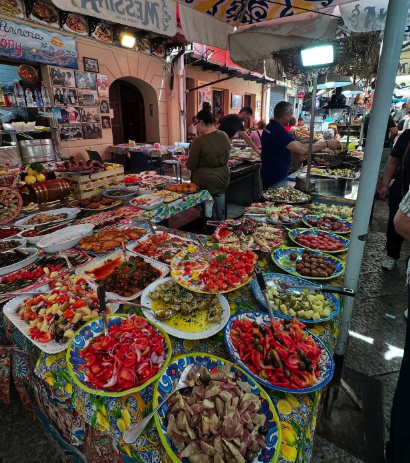
Palermo's historic markets feel closer to a North African souk than an Italian mercato — a legacy of the city's centuries under Arab rule. Vendors sing their prices in dialect (a tradition called the abbanniata), whole swordfish lie on ice, and fryers turn out arancine to order. Three markets anchor the city's food, and knowing which is which makes all the difference to how you plan your Palermo food tours.
The three markets at a glance
Each market has its own character, best time and specialities. Here's the quick comparison before we go deeper:
| Market | District | Best time | Known for |
|---|---|---|---|
| Capo | Seralcadio (near the Cathedral) | Morning | Easiest to eat through; fritters, sfincione, sweets |
| Ballaro | Albergheria | Morning | Oldest & largest; cheapest produce; most local |
| Vucciria | Near the old port | Evening | Nightlife, grilled stigghiola, bars in the piazza |
Mercato del Capo
Running through the Seralcadio district near the Cathedral, the Capo is a dense ribbon of stalls under faded awnings. It's primarily a food market, and one of the easiest to eat through, with panelle, sfincione, arancine and sweets sold alongside the produce and fish. It's busiest through the morning — go early to catch it in full swing, and follow it down towards Porta Carini.
Mercato di Ballaro
In the Albergheria quarter, the Ballaro is the oldest and largest of the three, and the most local. Its produce is famously cheap and fresh, and it's where several tours come for the deepest market experience: an espresso from a historic bar, arancine and sfincione from generations-old stalls, and the everyday bustle of Palermitani doing their shopping. If you want one market that feels entirely un-touristy, this is it.
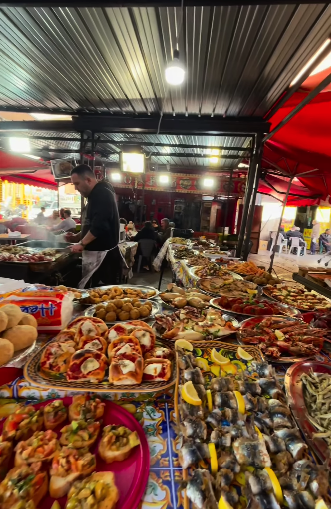
A Ballaro stall mid-morning — the market is at its liveliest before lunch.
Mercato della Vucciria
Near the old port, the Vucciria was once Palermo's grandest market, immortalised in Renato Guttuso's 1974 painting of the same name. By day it's now the quietest of the three, but after dark it transforms into one of the city's liveliest street-food and drinking scenes, with grills smoking in Piazza Caracciolo and young Palermitani spilling out of the bars. Evening food tours make the most of it.
One practical rhythm holds across all three markets. The Capo and Ballaro are morning-into-early-afternoon markets, fullest between roughly nine and one, when the fryers are going and the produce is fresh; by late afternoon they thin out. The Vucciria inverts this, dozing by day and filling with grills, music and drinkers from early evening into the night. If you plan a market-focused visit for the morning and keep the Vucciria for a separate evening, you will catch each at the hour it does best rather than arriving to find it half-shut. Weekdays are livelier than Sundays for the food markets, and Saturday mornings are the busiest of all, packed with locals doing their weekly shop — lively, but worth arriving early to beat.
Beyond food: what else the markets sell
The markets are not only about eating. Between the food stalls you will find spices sold loose, dried oregano and chilli, capers from the islands, sun-dried tomatoes, olives in a dozen cures, and Sicilian almonds and pistachios by the scoop — all of which travel home well and make better souvenirs than anything in a gift shop. There are stalls of ceramics and painted maiolica, kitchenware, cheap clothing and household goods, especially around the edges of the Ballaro. Buying a little produce, even just a bag of almonds or a jar of caponata, is also the easiest way to strike up a conversation with a vendor and see the market as the locals use it rather than as a photo opportunity. Bring a tote bag and small cash, and you can put together the makings of a picnic — bread, cheese, olives, tomatoes, fruit — for a few euros.
What to buy and taste
Beyond the fried classics — arancine, panelle, crocche, sfincione — the markets are the place to try what you'd never order in a restaurant: pani ca meusa, the spleen sandwich; stigghiola, grilled offal skewers; and, in season, fresh sheep's-milk ricotta, Sicilian blood oranges, prickly pears and almonds. Pastry counters at the edges sell cannoli filled on the spot. For the full dish-by-dish rundown, see the best street food to try in Palermo.
Borgo Vecchio and a suggested route
Beyond the famous three, a fourth market is worth knowing: Borgo Vecchio, between the port and the Politeama theatre, which wakes up in the late afternoon and evening and is a favourite for grilled meat, stigghiola and a beer among locals rather than tourists. It rounds out an evening if the Vucciria is busy.
If you have one morning and want to see the heart of it under your own steam, start early at the Capo near Porta Carini and eat your way down through the fritters and sfincione, cut across to the Cathedral, then walk south into the Ballaro through the Albergheria for the produce, the historic bars and the deepest local atmosphere. That single loop takes in two of the three markets, the Cathedral and the Quattro Canti in about half a day, at a pace that leaves plenty of time to stop and eat. Save the Vucciria for after dark on another evening, when it becomes a different place entirely.
Practical tips for first-timers
Carry small cash, as many stalls don't take cards. Keep bags zipped and phones secure in the crowds, as you would in any busy market anywhere. Don't over-order at the first stall — pace yourself across several so you can try more. And look for the queues of locals; they lead to the best fryers. For meeting points, opening rhythms and more logistics, our plan your visit page has the details.
Get the market right and you've cracked Palermo. Start early, eat widely, and let the noise and colour carry you.